Buried in Paperwork: How Federal Red Tape Is Strangling the American Entrepreneur

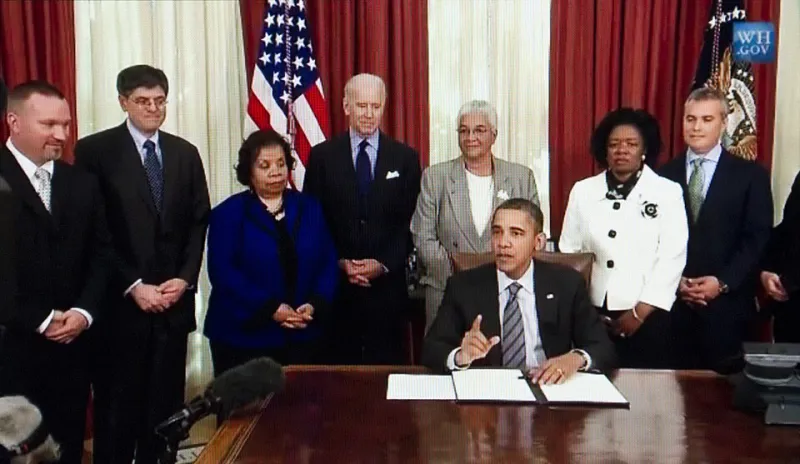
Photo: Gage Skidmore, CC BY-SA 3.0, via Wikimedia Commons
There is a particular kind of exhaustion that sets in when a business owner realizes she has spent her entire Monday — not developing a new product, not training her team, not calling on prospective clients — but filling out forms. Licensing renewals. Occupational safety disclosures. Payroll tax filings. Environmental compliance checklists. By Tuesday morning, the week is already behind.
This is not an isolated anecdote. Across the United States, small business owners are quietly losing the war against regulatory complexity, and the casualties are measured not in headlines but in hours.
The True Cost of Compliance
The National Federation of Independent Business has repeatedly documented that regulatory burden ranks among the top concerns for small business owners nationwide. A 2023 study by the National Small Business Association found that the average small business spends between $11,000 and $15,000 per employee annually on regulatory compliance costs. For a ten-person shop, that figure can exceed the annual salary of a junior hire.
But the dollar figures, staggering as they are, only tell part of the story. Time is the resource that cannot be recovered. When a restaurateur in Nashville spends forty-plus hours per week navigating health codes, liquor licensing renewals, Americans with Disabilities Act compliance audits, and city zoning reviews, those are forty hours stripped from menu development, staff mentorship, and customer experience — the very activities that determine whether a small business thrives or folds.
Mark Hendricks, who opened a small HVAC contracting firm in suburban Ohio five years ago, describes his experience candidly. "I went into business to fix things and employ people," he said. "Now I spend a significant portion of my week making sure I've checked every box for the EPA, OSHA, my state contractor's board, and the county. I've had to hire a part-time compliance consultant just to keep up. That's money I can't use to hire another technician."
Regulatory Complexity as a Competitive Weapon
Here is a dimension of this crisis that rarely receives the attention it deserves: large, established corporations do not merely tolerate regulatory complexity — they actively benefit from it.
When Congress or a state legislature drafts sweeping new rules, the Fortune 500 companies deploy armies of lawyers, lobbyists, and compliance officers to shape the language and then absorb the costs with relative ease. A multinational corporation with a $500 million revenue base can spread compliance overhead across its operations without breaking stride. A bakery with three locations and twelve employees cannot.
This phenomenon, sometimes called "regulatory capture," effectively transforms government rulemaking into a barrier to entry. The more complex and costly compliance becomes, the harder it is for startups and independent operators to compete. Incumbents, paradoxically, often champion new regulations because each additional rule is another moat dug around their market position.
Consider the craft brewing industry. When small breweries began challenging the dominance of major beer producers in the early 2000s, the established players lobbied aggressively for tighter distribution regulations in several states — rules that, not coincidentally, favored existing three-tier distribution arrangements that large brewers had already mastered. Many craft brewers spent years and significant legal fees navigating those barriers before some states reformed their laws.
The Federal Regulatory Inventory: A Number Worth Knowing
The federal government currently maintains over 185,000 pages of active regulations in the Code of Federal Regulations. That number has grown in virtually every administration, regardless of party. State and local rules layer on top of that foundation, creating a compliance environment of almost unfathomable complexity for the average entrepreneur.
The Small Business Administration's Office of Advocacy has estimated that the per-employee cost of federal regulatory compliance is significantly higher for firms with fewer than twenty employees than for large corporations. The disproportion is not incidental — it is structural. Rules written with large organizations in mind impose fixed compliance costs that small firms must absorb without the economies of scale that make those costs manageable for bigger players.
What Deregulation Could Unlock
The argument for meaningful deregulation is not an argument for lawlessness. Clean water, workplace safety, and honest financial dealing are legitimate public interests. The argument, rather, is for proportionality, clarity, and the elimination of rules that serve no discernible public benefit beyond the preservation of bureaucratic territory.
When the Trump administration implemented a "two-for-one" regulatory rollback requirement — mandating that two existing regulations be eliminated for every new one proposed — the result was a measurable reduction in compliance costs and a corresponding surge in small business optimism, as measured by NFIB surveys, to near-record highs. The economy did not descend into chaos. Air did not become unbreathable. It became marginally easier to start and run a business.
Imagine the economic energy that could be unleashed if Congress committed seriously to a comprehensive regulatory review — sunsetting rules that cannot demonstrate clear cost-benefit justification, streamlining licensing requirements that serve guild interests rather than public safety, and pre-empting the patchwork of conflicting state and local mandates that make interstate commerce unnecessarily burdensome.
Economists across the ideological spectrum acknowledge that regulatory reform holds significant potential for productivity growth. The question is whether the political will exists to challenge the entrenched interests — both bureaucratic and corporate — that profit from the status quo.
The Entrepreneur's Rightful Place
The American entrepreneurial tradition is not a relic. It is the living engine of job creation, innovation, and community vitality. The vast majority of net new jobs in this country are generated not by large corporations but by small and medium-sized businesses. Every unnecessary compliance burden placed on those businesses is, in a very real sense, a tax on employment and a brake on economic dynamism.
The free enterprise system functions best when individuals are empowered to take risks, serve customers well, and reap the rewards of their ingenuity. Government's proper role is to establish clear, fair rules of the road — not to construct an obstacle course that only the well-resourced can navigate.
For the entrepreneur staring at a stack of compliance paperwork on a Monday morning, the promise of America feels, at times, like a very distant thing. It does not have to be that way. Meaningful regulatory reform, grounded in respect for both market freedom and genuine public interest, is not only possible — it is overdue.